


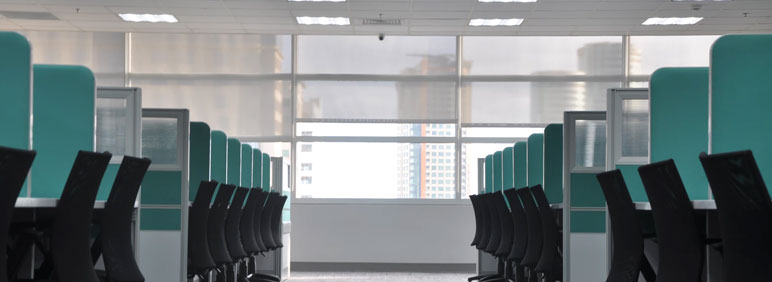
There are certain factors that are intrinsically associated with productivity in the workplace, but there is an important factor that most employers overlook, or simply ignore: office lighting. Reading in the dark can damage your eyes, we were told that from a young age, and there is more to it than that; poor lighting has effects beyond damaging the eyes. Therefore, choosing a lighting system for your office has a significant impact on the productivity of your employees.
Each area of your office has specific lighting needs. The light in the hallway is not the same as that in the meeting rooms, or even the reception area. In general, the aim is to use efficient but pleasant lighting that encourages concentration in offices and meeting rooms. Meanwhile, the reception area and recreational areas require a completely different light that makes it easier for your clients to orient themselves and feel comfortable.
Good lighting in the office is more than just a decorative and functional element. There are some lighting criteria common to any environment, such as adequate lighting, homogeneous distribution, and anti-glare lighting. It is essential to rely on and be guided by current legislation and regulations regarding the safety and health of workers, in order to choose an appropriate lighting system.
Disadvantages of artificial lighting
Dim artificial light can cause eye strain and headaches, since when the lighting is inadequate, the eyes are forced to work much harder to see correctly. In addition, dim light can cause drowsiness and lack of concentration, which is obviously counterproductive to the motivation of your employees.
Artificial light that is too harsh is also a problem; it is much more common than dim light and is just as harmful. Especially fluorescent lighting, which has a number of negative effects on your employees. It has been shown to cause eye strain, and can also cause headaches and migraines. This overly harsh lighting also makes it difficult to focus the eyes, so alternatives should be sought.
Alternatives for lighting your office
Traditional lighting systems have dim or insufficient lights, as well as harsh fluorescent lighting that requires considerable maintenance, affecting the costs of your office.
For this reason, modern office lighting installations currently incorporate very flexible solutions that adapt to the different spaces and lighting needs with reduced costs that are quickly amortized.
It is not only about saving costs, but about intelligently managing lighting to encourage the concentration of your employees. In recent years, interesting devices and automatic management systems have emerged that enable presence detection and establish lighting environments for different jobs.
These are light sensors that determine the existing natural light in order to adjust the natural light needed. And also motion or presence sensors that represent a saving in lighting of up to 70%.
Since light is a key component for our vision, and vision is responsible for 80 to 85% of our perception of the world, it is not difficult to understand that ignoring the appropriate lighting strategies in your office has a significant negative impact on productivity. By opting for more natural lighting, or other effective and non-harmful office lighting systems, you will not only save energy, but also increase the overall productivity of your company.